Matt Ball on the Decline of American Moviegoing
On the eve of July 4th, entertainment / metaverse / ‘spatial internet‘ strategist Matt Ball dropped his latest essay on a uniquely American phenomenon: theatrical moviegoing and its secular decline.
Matt Ball is one of the more ingenious commentators on the state of the entertainment industry, most famously as an early adopter of the modern conception of the ‘metaverse’, writing a seminal (and personally highly influential) essay on the Metaverse in January 2020, nearly 2 years before Facebook rebranded itself as Meta.
Ball has been a highly vocal booster of both Disney and Epic Games1 in recent history as two companies best placed to meet our metaverse future, pointing to the former’s dominance in original IP and ability to scale its film and television operations to meet seemingly unquenchable thirst for Marvel / Star Wars / Pixar fare, and the latter’s ability to support a proto-’metaverse’ where Darth Vader, an anonymous Green Bay Packers player, and the now-infamous, Epic-created virtual banana ‘Peely’ can all clash in its virtual battle royale environment.
While Matt Ball has broadened his aperture to focus on the wide ranging locus of the metaverse (including broadband latency, computing power, the limits of interoperability, cryptocurrency, etc.), his heart has always seemed to be in traditional film and television, where his professional and public career began. Underlining the importance of original ideas in a world increasingly saturated by the ‘mashup’ nature of LLMs, Walt Disney’s 1957 ‘flywheel’ illustration that served as highly influential source material for the metaverse concept places ‘Creative talent or Studio Theatrical Films’ at the center of its success.
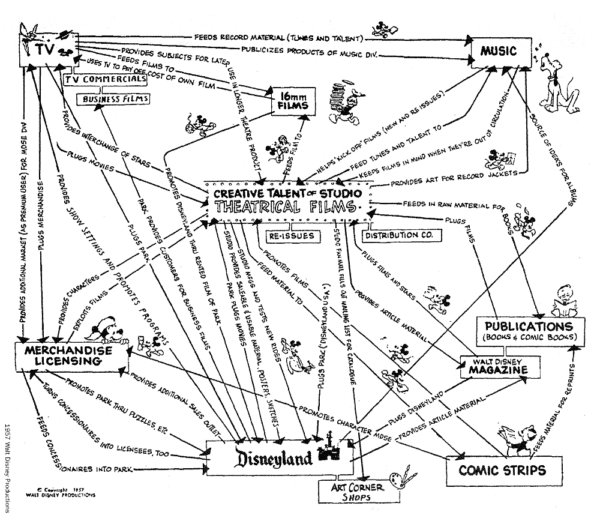
Ball uses his essay to analyze many of the common hypotheses behind the long-running decline in American moviegoing (down 33% in admissions per moviegoer since its peak in 2002, further exacerbated by COVID), including the advent of sequels, franchises, blockbusters and IP (“SFBIP”) and the associated lack of serious, adult dramas, the cost of moviegoing (including those pesky concessions), and the substitutive nature of the in-home viewing experience, as HD televisions at larger-and-larger sizes and subscription video on-demand (SVOD) has made at-home entertainment more and more compelling.
Ball takes a useful spin through the data behind to make several points:
1. Moviegoing frequency, rather than moviegoing itself, is the primary culprit
Interestingly, it’s not that people aren’t going to the movies – 74% of Americans bought a ticket in 2002, while 76% did in 2019, but that the frequency at which they’re doing so has precipitously declined – 2002’s per capita annual moviegoing admissions was 5.1 visits/year, declining to 3.4 movies/year as of 2019. During that same span, the share of those who went to the movies 1+ times per month declined from 28% to 11%.
Of the movies that people do attend, the much-maligned ‘SFBIP’ seem to be doing just fine – for every Oppenheimer standout there are numerous Super Mario, Avatar, and Marvel counterpoints that continue to break all-time box office and attendance records.
Additionally, whereas improvements to filmmaking technology and overall creation of media has made it easier-and-easier to make a film and even get it in theaters (350 films released in 2002, 900+ in 2019), the top 25 (namely made up of SFBIP, with the occasional outlier) have taken over a larger % of overall box office gross during this span.
This namely debunks the idea that these SFBIPs are crowding out consumer mindshare from the original comedies, adult dramas, and otherwise new/innovative fare and new voices from moviegoers attention.
2. Declines are concentrated among younger demographics
Amidst this overall decline, the impact is most pronounced among those younger than 24. Using a similar data set, Ball points out that while average American moviegoing has declined 20% (from 4.31 movies per year in 2009 to to 3.46 in 2019), those aged 2-11 declined 29%, 12-17 declined 38%, and 18-24 experienced the largest decline, 44%.
While these shifts in behavior are dramatic on their own, the primary explanation for massive declines are the heights at which they began, as these cohorts were previously prime demographics for movie theaters, collectively making up 47% of all moviegoers.
This is where I believe that substitutes are making a considerable dent – those aged 2-112 were popularly whisked to the theaters 4+ times per year to watch child-friendly fare along with parents or babysitters (now supplanted by the ubiquity of on-demand entertainment on phones, tablets and tv screens), while teen-fare for the mall-going set has been meaningfully supplanted by Fortnite, TikTok, and the variety of other boogeymen Jonathan Haidt is advancing.
As an aside, while it’s easy to bemoan the ‘anxious generation’ and their descent into smartphone hell, I would uncontroversially contend that moviegoing isn’t quite the ‘social’ activity that those with silver (screen) colored glasses might make it out to be. And while I’m sure there are benefits to the in-person engagement that mall-going enables, a lot of what makes Fortnite especially compelling to its players is the social engagement that takes place within the game, and that while TikTok is certainly a solitary activity, the ‘reactivation’ loop of sharing memes with friends is not so different than catching the latest movie to remain in the know back at school.
3. Other types of in-person, event-based entertainment are thriving
Amidst these worrying trends for theatergoing, especially among young people, and associated prevalence of at-home or mobile substitutes, it’d be easy to assume that other sorts of in-person, limited-time entertainment like live sports and concerts would be experiencing similar existential threats.
In fact, live entertainment (excluding movies) has never been more lucrative. Even before Taylor Swift may have singlehandedly delayed a planned Bank of England rate cut with her recent tour, the concept of a ‘billion dollar tour’ became common entertainment industry parlance.
At a larger scale, Ball’s numbers bear this out – with theatrical moviegoing experiencing an inflation-adjusted 37% total revenue growth (0.5% annually) in the 60-year period between 1959 and 2023, ticketed live entertainment (ie concerts) and live sports experienced a dramatic expansion during this span, experiencing 4.8% and 4.1% compound annual growth rate, respectively.
| (USD Billions) | 1959 | 2019 | % | CAGR |
| Theatrical Moviegoing | 9.8 | 13.4 | 37% | 0.5% |
| Ticketed Live Entertainment (excl sports) | 2.9 | 44 | 1,521% | 4.8% |
| Live Sports3 | 3.3 | 37 | 1,021% | 4.1% |
Source: Matt Ball, via Joel Finler & the Federal Reserve Bank of St. Louis
To my mind, driving this massive disparity is the concept of ‘event based’ or appointment viewing, where the primary draw of attending these events is being a part of something greater (think: Tiger King at the apex of the pandemic, or Squid Game a few years later), made even more lucrative by the scarcity of limited-run tours or events playing out in limited-capacity arenas4.
Bringing it back to movies, it’s clear that when a movie manages to surpass some unknown cultural hurdle of becoming an ‘event,’ whereby individuals experiencing movies in person collectively become part of something greater, the results tend to be massive – see: Gentleminions in 2022, or 2023’s Barbie (where gaggles of girls wearing pink became a cultural touchstone) and Barbenheimer trends.
In both cases (and many similar examples), these trends reached critical mass via a flywheel kick-started by teens and Tiktok before eventually reaching critical mass. This likely points to an even larger influence of SFBIP going forward – films that benefit from the awareness of an existing audience begin with much higher ‘floor’ than an unknown entity (even from well-known actors or filmmakers), making the prospect of an outsized outcome even more likely.
All of the above is a fascinating trend amidst Tiktok and YouTube’s algorithm-based recommendation engine’s contribution to continued fracturing of the cultural conversation – while Chris Anderson’s ‘Long Tail’ and Kevin Kelly’s 1,000 true fans continue to prove incredibly prescient, there seems to be an increasing incidence of ‘winner takes all’ from the biggest movies, concert acts, sporting events, etc.
Related Thoughts & Other Miscellenea
Amidst this broader trend and Ball’s helpful analysis, there are a number of interesting recent developments that monitor / track:
Disney Malaise; Rebooting the Marvel Cinematic Universe (MCU)
As Ball has popularly cited, the SFBIP trend is nearly ubiquitous with the rise of the Marvel Cinematic Universe, which began with a single (humble?) introduction of Robert Downey Jr. as Iron Man back in 2008 and reaching a nadir in 2021, where the MCU released 4 movies that collectively accounted for more than 20% (!) of all US box office revenues during that year.
2024 will be the first year since 2012 where Marvel will release just 1 movie (Deadpool & Wolverine, still slated to be among the biggest movies this year), amidst a broader turnover of its initial slate of movie stars tied to MCU Phases 1-5 (Downey Jr., Evans, Johansen, Hemsworth, etc) and dual concerns of the MCU ‘jumping the shark’ and a broader consumer exhaustion with the MCU’s wide variety of parallel timelines, characters, and multiverses (more common in weekly serialized comics, more convoluted when experienced in films made across 15 years).
Like Bob Iger prior to handing over the reigns of Disney to Bob Chapek, Marvel Studios President (and MCU architect) Kevin Feige was thought to be unassailable (or bulletproof, if you will), and now has to prove his mettle by proving out that the MCU can once again dominate the silver screen with the (re)introduction of new characters and means of weaving together storylines.
Similarly, the aforementioned Bob Iger, fresh from a victory lap into retirement5, has stepped back into his role as Disney CEO amidst the MCU reconstruction, significant malaise around the Star Wars franchise (apparently the latest Disney+ series the Acolyte has sent Star Wars devotees into a tailspin), while Disney Theme Park’s Star Wars experiential Galactic Starcruiser immersive experience announced it’s shutting down a little more than 2 years after its high-profile launch6, Wall Street’s break-up with cash-burning subscription video on-demand as a strategy for eventual success, and even the critical darling Pixar trying to re-find its movie magic (and citing a return to SFBIP to do so).
Seemingly nothing feels like steady ground for Disney at this moment, so it will be extremely interesting to see how Feige and Iger actively try to re-steer the ship at Disney, including potential Wall Street-focused machinations like strategic divestitures or spin-offs and fan-focused returns to core audiences.
Sony acquisition of Alamo Drafthouse
Following in the footsteps of Netflix’s purchase of the infamous Grauman’s Egyptian Theater in 2020 (and Tarantino’s stewardship of the New Beverly long before it), Sony recently announced its acquisition of the one-time movie-goers’ paradise, Alamo Drafthouse, which was experiencing significant financial distress following an ambitious, franchise-based national expansion.
Sony’s continued push into all things digital, including movies, video games and music, makes the dinner-and-a-movie Alamo Drafthouse experience a bit of an odd duck acquisition, but its press release announcement points to theatrical experience as a way to drive event-based ‘experiential entertainment’ from its plethora of movies, TV series, concerts, and video game offerings:
“We believe strongly in engaging entertainment fans outside the home in fun and distinctive ways as seen most recently with our Wheel of Fortune LIVE! traveling tour, and the opening of Wonderverse in Chicago,” *said Ahuja. “Alamo Drafthouse’s differentiated movie-going experience, admired brand and devoted community fit well with this vision. * Our Crunchyroll business also aligns well with their audience’s interests. We look forward to building upon the innovations that have made Alamo Drafthouse successful and will, of course, continue to welcome content from all studios and distributors.”
This could be a harbinger of an interesting strategy (and one potential realization of the long-purported ‘One Sony’ strategy) – an attempt to leverage the movie theater as more of an ‘must-attend,’ event space for Sony Interactive Entertainment video game launches or streamer events, Crunchyroll Cosplay ‘cons’, or simulcast live concerts or movies like Beyonce’s Renaissance Tour film.
In any case, while 2025 promises to be a return to box office superlatives driven by lucrative SFBIF – with more video game IP, live action adaptations of animated classics, and sequels galore, it remains to be seen whether this will represent a continuation of the ongoing decline, or whether new strategy will emerge that potentially draws inspiration from the continued success of other in-person entertainment7.
=================
1 Whether or not he had his hand in Disney’s cash infusion into Epic (ahem, “‘to create expansive and open games and entertainment universe connected to Fortnite”), hasn’t been publicly disclosed
2 Maybe un-notably, the study excludes 2-year olds and below, which is a increasingly reversing trend, as Jia Tolentino recently explained in the New Yorker on Cocomelon and its seemingly more nefarious imitators
3 Note that this entirely excludes the additional revenue stream from streaming rights, where amidst a continuous and ongoing decline of the broader cable television industry, the NBA is nearing a $76B deal for the rights to broadcast their products, while the NFL continues to blow all other sports out of the water, recently selling livestreaming rights for a single game for $110M (or more than $600,000/minute, assuming a 3-hour game)
4 Anecdotal, but a common theme I heard from parents of teenage daughters was finding arbitrage by purchasing Taylor Swift tour tickets in Eastern European cities, which remained cheaper than a US-based ticket even after accounting for travel, accommodations, food, etc.
5 Iger’s career is well-recounted in his memoir, which I’d recommend for anyone working in the entertainment industry
6 The failings of the Galactic Starcruiser experience are recounted in excruciating, well-credentialed detail in this 4-hour takedown (h/t Joost van Dreunen)
7 …but maybe not sports-inspired tiered pricing